Most STEM people finish their course projects, submit the report, and close the laptop. The work disappears. But in a field where credibility is built slowly — through publications, degrees, and years of work history — a well-documented project is one of the few fast moves available to early-career candidates. This article maps out how STEM candidates are actually evaluated, surveys the main credibility channels, and then goes deep on one pipeline most people leave entirely on the table: the projects they’ve already done, and how to turn them into public, searchable, citable proof of what they can build.
大多數理工背景的學生,交完期末報告就把專題束之高閣了。花了好幾週做出來的東西,就這樣悄悄消失。但在一個靠著發論文、拿學歷、累積資歷才能慢慢建立信譽的領域,一份整理得好的課程專題,是少數讓你可以提早被看見的機會。這篇文章會先拆解理工人才實際上是怎麼被評估的,再盤點幾個主要的信譽建立管道,最後深入討論一條幾乎所有人都沒有好好利用的路:你已經做完的那些專題,以及怎麼把它們變成公開、可搜尋、可引用的作品紀錄。
Opening
Most STEM people are sitting on credibility assets they’ve already built and never shipped.
A course project report submitted at the end of a semester. A simulation that ran correctly once and was never shown to anyone outside the class. A personal project that lives in a private GitHub repo because it “isn’t ready yet.” These artifacts cost weeks of real work — and then quietly disappear.
This article is about preventing that. We’ll first look at how STEM candidates are actually evaluated, in both academia and industry. Then we’ll survey the main channels for building credibility. Finally, we’ll go deep on one specific channel that is consistently underused: the projects you’ve already done, and the pipeline for turning them into public, searchable proof of what you can do.
How STEM candidates are evaluated?
Before figuring out how to prove yourself, it helps to understand who is doing the evaluating — and what they actually look for.
The rules differ depending on whether you’re targeting academia or industry.
Academic: Publications, Preprints, and Research Impact
If your goal is to become a professor or a research scientist at a national lab, the evaluation criteria are relatively well-defined: publications in peer-reviewed journals and conferences, citation counts, h-index, the prestige of your institutional affiliations, and your PhD advisor’s reputation. In this world, credentials are retrospective and cumulative — they reflect a long track record, not a single moment.
This article will not spend much time here. If you’re on an academic track, you already know the rules. The problem is not that the rules are unclear; the problem is that the game is slow, and the feedback loop is long.
Industry: Career Trajectory, Skills, and Personal Branding
For most STEM candidates — those entering industry as new grads or transitioning between roles — the evaluation process is less systematic and more human than it appears.
What hiring managers actually do:
In the vast majority of cases, a recruiter spends 30–60 seconds on a resume and decides whether to pass it forward. They are pattern-matching against a mental template: Does this person have the right degree? The right company names? The right keywords? The resume is not a proof of competence — it is a filter for getting into the room.
Deeper evaluation happens in interviews, which test a different set of things: problem-solving under pressure, communication clarity, and cultural fit. Technical interviews (LeetCode-style, system design, or domain-specific) are a proxy for competence, but a noisy one.
The rare case — inbound discovery:
Occasionally, the dynamic flips. A hiring manager is looking for someone with expertise in a specific niche — say, FPGA-based neural network accelerators, or computational fluid dynamics for turbomachinery — and they search for it directly. If you have a paper, a GitHub repo, or a blog post that surfaces in that search, you may receive an inbound inquiry without ever submitting a resume. This is rare, but not impossible, and it is structurally different from the resume game: you’re not competing against a stack of applicants; you become the only result.
The rest of this article is primarily about building toward that second scenario — not by waiting for luck, but by systematically converting work already completed into public, searchable, self-verifying artifacts.
The credibility toolkit — survey of channels
Journal and Conference Publications (Papers)
This is the gold standard for credibility, but the peer review process is slow by design. A typical submission-to-publication cycle runs 6–12 months at minimum — and that assumes no desk rejection, no major revision round, and no production backlog. Rejections restart the clock entirely.
The rigor is the point. A publication is not just a signal of what you know; it is a signal of what others have independently verified. That weight is earned through the wait.
For most new grads and engineers, this channel is inaccessible in the short term — not because the work isn’t there, but because the timeline doesn’t fit the job search cycle. The channels below are faster, and for many purposes, sufficient.
Preprints Publications (arXiv and others)
The preprint ecosystem was built to solve a specific problem: the latency between completing research and making it visible to the community. Platforms like arXiv pioneered this model by allowing researchers to publicly post full manuscripts before formal peer review. Instead of waiting months, work becomes searchable and citable within days to about a week, depending on moderation.
In practice, preprint servers function as a parallel dissemination channel to journals, not a replacement. They establish priority, enable rapid feedback, and increase accessibility. In fields such as computer science and machine learning, preprints are standard practice and often carry substantial signaling value in both academia and industry. More broadly, preprints are now a core component of open science, enabling faster and wider distribution of research findings.
A few things to be aware of. First, preprint platforms are not a free-for-all. Most (including arXiv) have moderation processes to filter out spam and clearly substandard submissions. Second, preprints are persistent records. Once posted, they are difficult to remove; corrections are typically handled via updated versions or withdrawal notices rather than deletion. This design preserves the integrity and traceability of the scientific record.
Also, not every STEM field is well covered by arXiv categories. The ecosystem is therefore fragmented across multiple field-specific and general-purpose servers, often operated by different organizations. Below are some commonly used alternatives across STEM domains:
- bioRxiv: biology and life sciences
- medRxiv: health sciences and medicine
- ChemRxiv: chemistry
- PsyArXiv: psychology and social sciences
- TechRxiv: electrical engineering, computer engineering, and technology
- engrXiv: general engineering
- EarthArXiv: earth and planetary sciences
- OSF Preprints: multidisciplinary aggregation platform
- Research Square: publisher-integrated preprint platform
More relevantly for this article: a preprint is often the natural endpoint for a course or personal project that has been developed into a serious write-up. It requires no institutional gatekeeper, no journal acceptance, and no publication fee. If the work is technically sound and clearly written, it can be made publicly visible and citable immediately.
Career Trajectory and Work Experience
A resume is a timeline, and timelines are read backwards. Hiring managers and PhD admissions committees are
not evaluating who you are today, they are inferring your possibility from where you have been. This makes career
trajectory a lagging indicator: it reflects past decisions and environments, not current capability.
That said, it is still the primary signal most evaluators rely on, which means understanding how each stage
is interpreted is worth the effort.
Performance in different stages implies different things
Here, let’s take a quick tour of how performance at different stages of the typical STEM pipeline is interpreted by evaluators:
High school
In Taiwan, South Korea, China, and parts of Europe, high school ends with a high-stakes standardized entrance exam. A strong result here signals something specific: at the age when most peers are maximizing leisure, you chose — or were disciplined enough — to sit down and do the work. It is an early indicator of conscientiousness and pressure tolerance, not raw intelligence. Evaluators from these systems understand this signal. Evaluators from systems without these exams (most U.S. universities) often do not weight it accordingly.
Undergraduate
Undergraduate GPA and institution prestige are used as a proxy for sustained effort over four years. The signal is weakened by grade inflation at many institutions, which is why research experience, thesis quality, and faculty recommendations carry increasing weight for graduate admissions. For industry hiring at the entry level, the undergraduate institution still functions as a rough prior — not because it measures ability accurately, but because it is a fast filter.
Graduate school (Master’s or PhD)
Graduate school trajectory is interpreted directionally. The general expectation is upward mobility — applying to, and being accepted by, a program at a stronger institution than your undergraduate degree. Deviations from this pattern invite interpretation:
- Same institution as undergrad: read as either strong loyalty to a specific lab, or insufficient ambition to test oneself elsewhere. Context determines which.
- Weaker institution than undergrad: prompts the question of what happened — rejected elsewhere, following an advisor, or pragmatic about funding? Without an explanation, evaluators fill the gap negatively.
- Stronger institution but lower-ranked program within it: partially mitigates the upgrade, since admission selectivity varies significantly by program even within the same university.
The strongest positioning, all else equal, is a competitive program at a genuinely better institution. Not because prestige is the goal, but because it signals you were evaluated by a new set of people and elevated.
First full-time job
The first job establishes a baseline. Two dimensions are evaluated: the quality of the employer, and what you did while you were there.
Duration matters more than most early-career candidates realize.
- Leaving within 6-12 months, especially from a demanding employer, is typically read as an inability to handle the environment, regardless of the actual reason. The threshold for “explainable departure” is approximately 12–18 months. Below that, you are in a position of having to justify the exit in every subsequent interview.
- Staying too long without visible progression is also penalized. Three to four years at the same level, with no promotion, no expanded scope, and no notable output, raises the question of ceiling. The ideal first-job trajectory is: stay long enough to complete something tangible, obtain a credential the employer can provide (promotion, lead role, shipped product, internal award), and leave with a story that is coherent under questioning.
One structural note for engineers in Taiwan and adjacent industries: the TSMC new-hire attrition pattern is well known to local hiring managers. Leaving TSMC process engineering after one year is interpreted charitably by some (high bar, self-aware about fit) and harshly by others (couldn’t handle it). The interpretation depends heavily on what came next — which is true of most career transitions.
Certificates and Skills
Beyond degrees, the strongest credential is arguably a professional license (like medical licenses for doctors). STEM professionals can build credibility through certifications, though with important limitations:
- Not every STEM subfiled has corresponding certificates.
- Earning a certificate requires extra time and effort, and it should align with your career trajectory.
- Many certificates lack widespread recognition; hiring managers may not understand their value.
LinkedIn and Personal Branding
LinkedIn offers a fast channel to share work. Many create accounts for job hunting but never post; others post constantly but mostly share news rather than original work. It’s easy to blur into that crowd — noise disguised as thought leadership. To stand out, share your work in ways that are genuinely informative and add perspective, not just repackaged hype.
Personal Website and Blog
Writing is a powerful way to not only build cognitive clarity but also create a lasting, searchable record of your thinking. As publication on journals, conferences, and arXiv requires process by another party, a personal website and blog give you full control over what you share and how you present it.
In my Personal Websites as the Ultimate Creator Platform | Not to Go Viral but to Leave a Trail, I have discussed that many creator platforms optimize for speed—algorithmic reach, instant feedback, and rapid decay. This works for short-term visibility on social media, but not for work that compounds over years. After comparing major creator platforms across six structural properties, personal websites uniquely support long-horizon creators who aim to leave a durable, searchable trail rather than go viral.
In addition, consistent, high-quality output (not just writing) will bring more oppertunities such as speech invitations, consulting offers, book puhlicatioin invitations, and even job offers. These long-term reputations will strenthen your credibility in the field.
The underutilized channel: course and personal projects
New graduates and students often accumulate course projects, theses, or personal projects that sit dormant. Similarly, those already in industry may have internal tools or side projects that never leave private repositories. Yet these artifacts — when polished and shared — can become some of the strongest credibility signals available to early-career STEM professionals, precisely because so few people bother.
Related to your professionality, there might be work such as:
- Personal projects
- Course projects
These can all be truned into valuable assets for personal branding. Let’s focus on course projects for now, since they are more common and often more structured than personal projects. The same principles can be applied to personal projects as well.
The pipeline: from course project to public portfolio
A course project has a wider range of possible outcomes than most students realize — and they are not equally likely, but they are all real.
At minimum, it helps you pass the course. With one deliberate step further, it becomes a resume line. With a few more, it becomes a LinkedIn post that surfaces in a recruiter’s search, a blog post that accumulates traffic for years, or a citable arXiv preprint that establishes your name in a subfield. In rare but documented cases, it becomes the seed of a job offer from a company that found you without you ever submitting a resume — or a funded startup.
- A course project that helps you pass the course.
- A few extra lines on your resume.
- A LinkedIn post that a recruiter finds six months later.
- A blog post that ranks on Google and keeps working while you sleep.
- An arXiv preprint with your name on a citable, dated record.
- A journal or conference publication with peer-verified credibility.
- A job offer or PhD admission from someone who found your work first.
- A startup. It has happened before — more than once.
The ceiling is genuinely open. The floor — finishing the project, submitting the report, and closing the laptop — is where most people stop. This section is about everything between the floor and the ceiling, and how little extra work each step actually requires.
Course projects have become startups before
The most cited example is Google. Larry Page and Sergey Brin developed the PageRank algorithm as a PhD research project at Stanford, grounded in the problem of ranking web pages by link structure. What began as an academic exploration of information retrieval demonstrated sufficient technical novelty and real-world scalability that they founded Google in 1998. For the full origin story, see Google’s own account. The pattern — a well-framed problem, a working prototype, and a growing market need — recurs across many successful companies. The project doesn’t need to be world-changing at submission time. It needs to be real, honest, and public.
The two most common reasons STEM people don’t share their course projects are straightforward:
- The project doesn’t feel finished enough to show.
- They worry someone will steal the idea before they can do something with it.
Both are understandable. Neither holds up.
On the “not finished” problem: the threshold most people are waiting for doesn’t exist. A README that describes what you’re building and why, posted on a public GitHub repo in week two of a semester, is not a claim that the work is done. It is a dated record that the work exists and that you are the one doing it. The same applies to a LinkedIn post at proposal stage, or a blog post written from a progress report. None of these require the project to be complete. They require the project to be real — which it already is.
On idea theft: this fear has the causality backwards. GitHub commits are timestamped public records. arXiv submissions receive a permanent dated identifier upon posting. Publishing early is precisely how priority is established in research — it is the mechanism that protects your claim, not the thing that surrenders it. Keeping a project private until it is “ready” leaves you with no timestamp at all.
The evidence on sharing is consistent. A 2024 analysis in PLOS ONE found that sharing research data, code, and preprints measurably increases citation counts and community reach. Research on recruiter behavior shows that public GitHub portfolios give hiring managers concrete, inspectable evidence of how a candidate thinks and builds — something a resume line cannot provide. And work on open science collaboration documents how public repositories accelerate feedback cycles and attract contributors who would never have found the project otherwise. A guide written for HR and technical recruiters makes the same point from the other side of the table: portfolios and repos are evaluated as evidence of judgment, not just output.
Sharing doesn’t require the project to be perfect. It requires the project to be visible.
A timeline view: repurpose what you’re already producing
Most people think sharing requires extra work on top of coursework. It doesn’t. Every course with a structured project already forces you to produce the right artifacts on a schedule — a proposal, a progress report, a final report. The only question is whether those artifacts go into a grade submission folder and disappear, or whether they get one more push into a public channel.
The diagram above maps the standard course timeline (green) against a parallel marketing timeline (blue). The blue actions do not require new content — they require new destinations for content you are already writing.
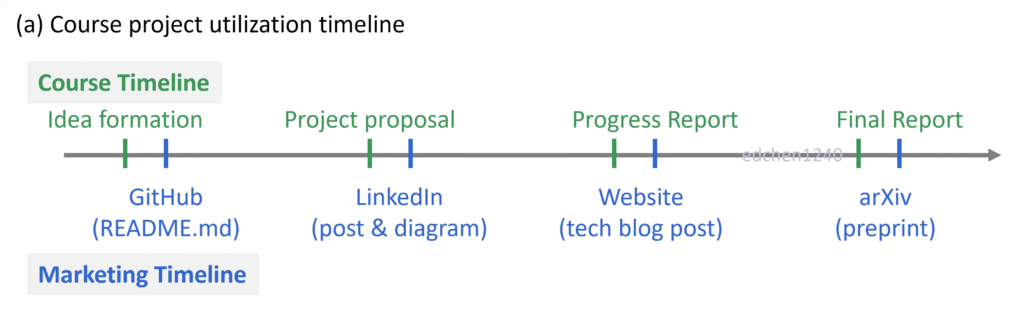
Idea formation → GitHub
Before the first deliverable is due, a repo should already exist. Make it public if there are no confidentiality constraints. Write a proper README.md — not as documentation for a finished project, but as a one-paragraph statement of what you are building and why. GitHub timestamps commits; this establishes priority from day one. Any future collaborator, recruiter, or reviewer can see when the work started.
Project proposal → LinkedIn
When the proposal is submitted, post about it on LinkedIn. Not a summary of the document — a short statement of the problem you are trying to solve and why it matters. One paragraph is enough. The goal is not engagement; it is timestamp and discoverability. Recruiters searching for people working on your topic area will surface this post long after you have forgotten about it.
Progress report → Blog post
A progress report is already a structured narrative: what you planned, what you built, what you learned, what is left. Convert it into a blog post. Keep the technical substance; remove the grading-facing framing. Link the GitHub repo. Add the blog post URL as a comment on your original LinkedIn post. This is the stage where SEO starts accumulating — a post indexed in month three of a semester will have months of search exposure before you graduate.
Final report → arXiv or journal submission
After the semester ends, invest one to two weeks converting the final report into a preprint-formatted write-up. Submit to arXiv. The paper does not need to be groundbreaking — it needs to be technically honest, clearly written, and publicly citable. For a new grad, one arXiv preprint in a relevant subfield changes the inbound search result from zero to one. That is a non-trivial shift.
What if the course is over and I’ve graduated?
Don’t worry. It’s still worth doing this. Knowledge is non-perishable if properly contextualized. Your project’s value comes not from being first, but from clarity, positioning, and accessibility. The only difference is that the work becomes a repositioning problem rather than a novelty problem.
What if new work appeared after my project?
This is the most common concern. Don’t ignore it — cite it. Better yet, do temporal positioning. Frame it explicitly:
- “At the time of this project (2023), X was not explored…”
- “Subsequent work (2024–2025) has addressed Y…”
- “This work provides an alternative perspective focusing on Z…”
This transforms the narrative from outdated to historically situated.
Don’t just claim your work is similar but earlier. Identify your axis of differentiation: Are you answering a different question? Working under tighter constraints? Offering a different kind of insight? Trading off different variables? Pick one clear axis. This is the core intellectual work.
How should I frame the scope?
Use research terminology, not startup terminology. Prefer “proof-of-concept,” “exploratory study,” or “preliminary results” over “MVP” — this signals rigor and scope awareness to academic audiences.
What’s the minimum quality bar?
If time is limited, don’t run new experiments — just ship. But enforce a minimum viable preprint: clear problem statement, coherent method description, at least one defensible result, an honest limitations section, and updated related work. Without these, you risk negative signaling rather than positive career impact.
Should I tell my teammates about this?
Yes — as a courtesy, let them know you’re planning to ship the project as a preprint. Ask if they want to be involved. If they do, they get their name on the author list. If not, acknowledge them properly.
That said, don’t confuse notification with re-engagement. Running new experiments together post-course is a different question. Coordination costs are high once the semester ends. People might have already moved on to different journey; schedules diverge, incentives misalign, and momentum stalls. If additional experiments would materially improve the work, it may be worth it. Otherwise, a single-author or small-author conversion with proper acknowledgment is often faster to ship.
How do I maximize discoverability?
Include a time gap disclosure: “This manuscript is based on work originally conducted in [year], with updated contextualization.” This builds trust. Beyond that, optimize the basics — clear title, focused abstract, GitHub repo with reproducible code, and data access instructions. A clean, public proof of thinking, execution, and taste is what actually gets found and matters.
A final note on the competitive landscape
You’re not reviving an old project. You’re repositioning it as a coherent, citable contribution in today’s landscape. The temporal positioning approach above shows how — by being explicit about the knowledge state when you did the work, and where the field has moved since. You’re not competing on being first; you’re competing on clarity, engineering quality, and taste.
How the four channels reinforce each other through SEO
Each public artifact in this pipeline has a different relationship with search indexing — and they are more powerful linked together than standing alone.
GitHub is indexed by Google, but on its own timeline. It typically takes one to two weeks for Google to discover and crawl a new public repo, and unlike a personal website, you cannot submit it directly to Google Search Console to request indexing.
Your personal website/blog, by contrast, can be submitted directly to GSC for faster indexing. This is the practical workaround: when you publish a blog post and submit it to GSC, Googlebot crawls that page and discovers the outbound links in it — including your repo URL — adding them to Google’s crawl queue. This doesn’t guarantee immediate indexing of the linked pages, but it reliably accelerates discovery. A well-structured README.md with a clear title, relevant keywords, and a link back to your blog post amplifies this effect by creating a bidirectional crawl path.
LinkedIn serves a different role in this ecosystem. It acts as an early-stage discovery and timestamp channel — useful when you first post about your project proposal. It has immediate reach within your network and can surface to recruiters searching for keywords related to your work. However, LinkedIn content decays quickly (see Technical writing as a compounding asset below) and is not part of the permanent SEO structure. Its primary value is as a catalyst that directs attention to the more durable channels — specifically your blog post, which serves as the high-context landing page for non-technical readers before they navigate to your GitHub repo or arXiv preprint.
arXiv carries the strongest domain authority of the four. arXiv.org is a high-trust, heavily indexed domain, and papers posted there surface reliably in Google Scholar and general web search. One convention worth respecting: arXiv preprints should link to your GitHub repo (code and data references are standard), but not to your LinkedIn or personal blog, because those links read as promotional and can undermine the academic tone of the document. After the preprint is published, place the arXiv DOI link on your GitHub repo and blog post to complete the circuit.
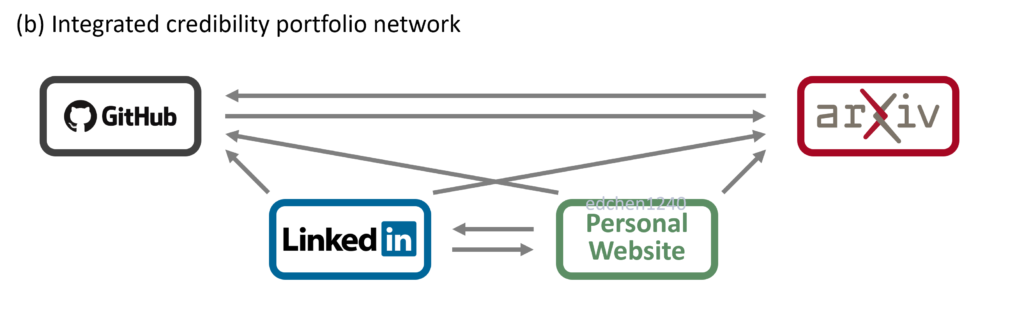
The target cross-linking structure is as follows (note: arrows are directed — the diagram should use single-headed arrows reflecting who links to whom):
- GitHub repo → links to blog post and arXiv preprint.
- Blog post → links to GitHub repo, arXiv preprint, and LinkedIn profile.
- LinkedIn post → links to GitHub repo, arXiv preprint, and Blog post.
- arXiv preprint → links to GitHub repo only.
This forms an asymmetric, dual-hub topology. The blog post serves as the long-term SEO hub — the only artifact that links to all three other channels and accumulates search authority over time. The LinkedIn post serves as the short-term broadcast hub, distributing immediate attention across the same three channels during its brief window of feed visibility. arXiv and GitHub function as high-authority destination nodes with constrained outbound links (arXiv by academic convention, GitHub by structural role). The entire network compounds over time: each node strengthens the discoverability of the others, and the dual-hub structure ensures both immediate reach and durable indexing.
Technical writing as a compounding asset
Each channel in this pipeline decays at a different rate — and that difference matters more than most people expect.
A LinkedIn post has a half-life of roughly two to three days. After that, the algorithm stops surfacing it and organic reach drops to near zero. It is useful for the moment of publication, and for the timestamp it creates, but not as a durable asset.
A blog post behaves differently. It gets indexed, accumulates backlinks, and continues to surface in search results for years — often peaking in traffic long after you’ve forgotten you wrote it. Beyond any single article, your domain itself builds authority over time: each post you publish strengthens the next one’s discoverability. Writing early and consistently means your past self is doing SEO work for your future self.
An arXiv preprint is citable indefinitely. It does not decay. Once posted, it exists as a permanent, dated, searchable record that any researcher, hiring manager, or collaborator can find and reference years from now.
The practical implication: the blog post is the underrated middle layer. It lives longer than social media, costs less than a publication, and — if written clearly — does compounding work that a private GitHub repo or a resume line simply cannot.
Closing
I took nearly half the machine learning courses MIT had to offer — 6.8610 Quantitative Methods for NLP, 6.8300 Advances in Computer Vision, 6.8711 Computational Systems Biology, 6.7960 Deep Learning. Each came with a serious course project. I did the work. I submitted the reports. And then I closed the laptop.
I figured out this pipeline only in the final stretch of my PhD. By then, most of those projects had quietly disappeared — no public repo, no blog post, no preprint. Work that could have been a searchable, citable record of what I was building for five years just… wasn’t.
If you’re earlier in that arc than I was — undergrad, master’s, or the first few years of a PhD — you still have time to do this differently. The projects are already there. The deliverables are already being written. The only thing missing is one more step at the end of each one.


2 Comments
zengdao2023 · 2026-03-25 at 07:34
STEM Portfolio BuildingI like how you frame course projects as a kind of ‘missed distribution problem’ rather than a lack of ability—most people really do stop at submission. The idea of making projects searchable and citable also feels underrated, especially since it compounds over time with technical writing and SEO. It would be interesting to hear your take on what level of polish is “good enough” before publishing, since that seems to be a common blocker.
Banana · 2026-03-25 at 17:04
This resonates deeply with my own experience—spending weeks on a project only to have it vanish after the grade. The idea of turning course work into a public portfolio is a game-changer, especially for early-career professionals who need to build credibility quickly. It’s a practical step that bridges the gap between academic work and real-world impact.